Direct answer
Measure the tree's height from the soil to the top, its widest canopy spread, and the trunk's thickness just above the surface roots. For an oval or rectangular pot, the length should be about two-thirds of the height — or of the spread, if the tree is wider than it is tall. The depth should be about the trunk's thickness. Cascades take deeper pots, forests shallower, and a tree still in training can go larger.
Key takeaways
- Three numbers: height, spread, trunk caliper above the roots.
- Length ≈ ⅔ of height (or of spread for wide trees); depth ≈ trunk caliper.
- For round pots the sources disagree — about ⅓ or about ⅔ of height. Look at the tree.
- Listings mix inches and centimetres, outside and inside sizes. Read which.
- The calculator below turns your numbers into a size — and into real pots in stock.
01 — MEASURE THE TREE
Three numbers,
one tape.
Height — from the soil surface to the highest point of the tree, measured straight up, not along the trunk. Spread — the widest distance across the canopy, tip to tip, seen from the front. Trunk caliper — the thickness of the trunk just above the surface roots, where the trunk leaves the roots behind; Bonsai Empire uses exactly this point for the depth rule.[2]
Measure in whichever unit your tape has; the calculator converts. The study below shows all three on one tree, measured on the image.
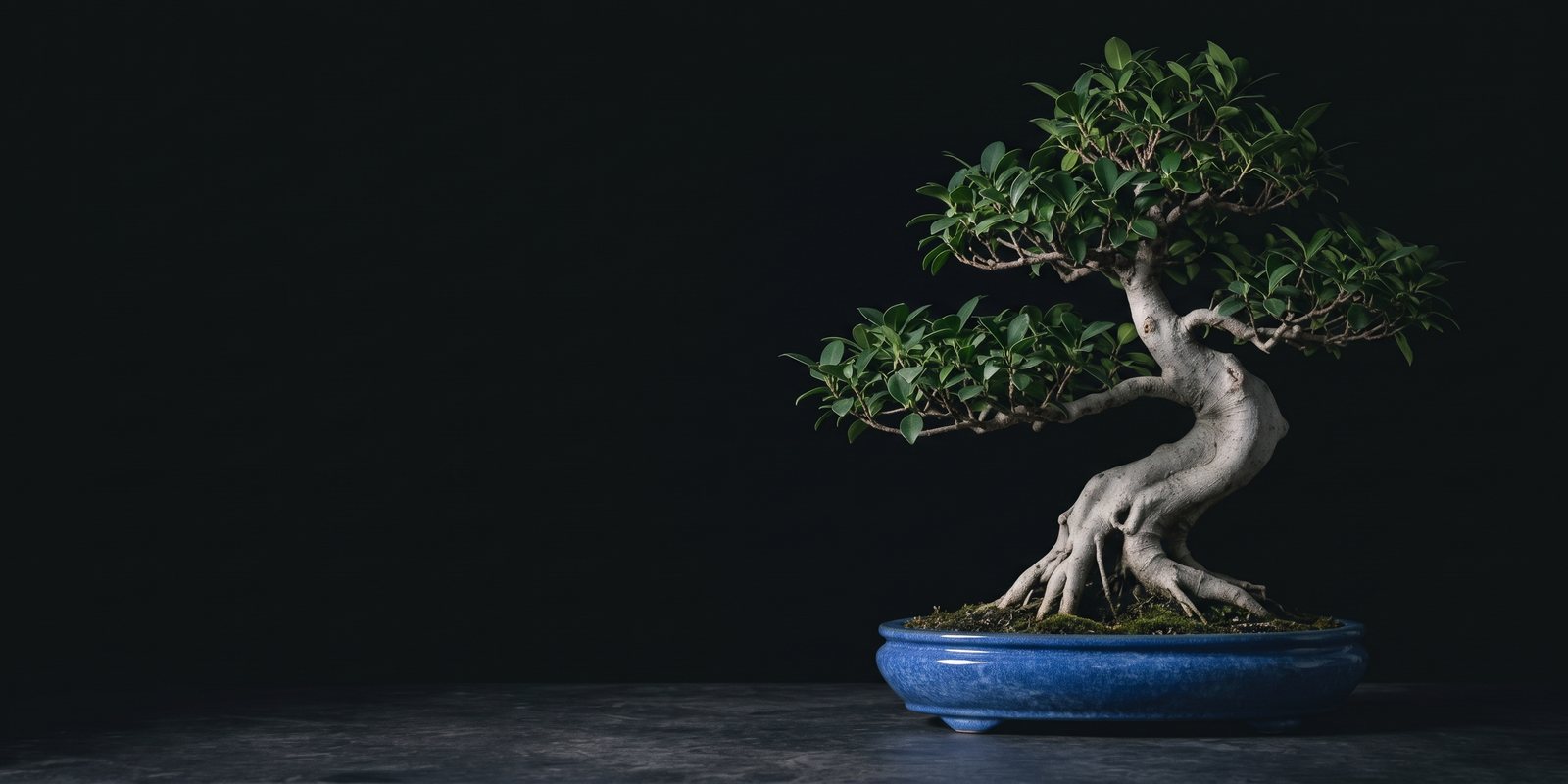 TREE HEIGHT H
CANOPY SPREAD
CALIPER
POT LENGTH ≈ ⅔ H
DEPTH ≈ CALIPER
02 — THE RULES, AND THE EXCEPTIONS
Two-thirds,
and the trunk.
Two rules appear in every source we read. The length of an oval or rectangular pot is about two-thirds of the tree's height, and the depth is about the thickness of the trunk base.[1][2] Bonsai Outlet adds one more case: for spreading, canopy-style trees, use two-thirds of the widest spread instead of the height.[3] Bonsai Empire makes a related point for round and square pots — when foliage is unusually large, the pot widens and its height is lowered to compensate.[2]
The exceptions are styles. Forests and group plantings go in very shallow pots; cascades and semi-cascades need deep, heavy pots as a physical and visual counterweight.[1] And the rules describe a finished tree: younger trees in development can go in larger pots to encourage growth.[2]
| Dimension | Rule | Source | Our note |
|---|---|---|---|
| Length, oval or rectangle | ≈ ⅔ of tree height | Bonsai Empire; Bonsai Outlet[1][3] | The rule everyone agrees on |
| Length, wide canopy | ≈ ⅔ of the widest spread | Bonsai Outlet[3] | Our reading: use it when the canopy is wider than the tree is tall |
| Diameter, round or square | ≈ ⅓ of height / ≈ ⅔ of height | Bonsai Empire / Bonsai Outlet[2][3] | The sources disagree; ⅓ suits tall literati, ⅔ a broad tree |
| Depth | ≈ trunk thickness just above the roots | Bonsai Empire; Bonsai Outlet[1][3] | Heavier trunk, deeper pot |
| Depth, forest or group | Very shallow | Bonsai Empire[1] | — |
| Depth, cascade | Deep and heavy | Bonsai Empire[1] | The rule above does not apply |
| Tree in training | Larger is fine | Bonsai Empire[2] | Size for health first, display later |
Fits
- Length about ⅔ of the height (or spread) of a finished tree
- Depth close to the trunk caliper
- A wider, lower pot under a broad canopy
- Drainage holes, always[2]
Rarely fits
- A deep pot under a slender trunk — the tree looks lost
- A pot shorter than half the height — top-heavy, in our reading
- Shallow pots under cascades
- Display sizes for a tree that still needs to grow
03 — THE CALCULATOR
Your tree,
in numbers.
Enter the three measurements. The calculator applies the rules above and lists real pots from our checked list that fall within about 15% of the length and near the depth. Where a seller states the inside depth, the calculator uses it; otherwise it uses the outside height. It runs in your browser; nothing is sent anywhere. Pot prices and stock checked November 12, 2026.
04 — READING A LISTING
The numbers,
not the photograph.
A photograph cannot tell you size; the listing can, if you read it closely. Three habits catch most mistakes. First, find the unit: American sellers often name a pot by its length in inches ("an 11-inch oval"), while the dimension line may be in centimetres. Second, find which way round the numbers go — most give length × width × height, and the height is the depth you care about. Third, check whether the depth is outside or inside: a pot with feet and a thick floor holds less soil than its outside height suggests.
TWO REAL LISTINGS
What a good
listing says.
Both state the size in words you can check against the calculator.
05 — THREE PATHS, REAL POTS
Three pots,
three trunks.
Three oval pots of 25–29 cm, right for finished trees of about 15–17 inches, at three different outside depths — 3½, 2 and 2 inches — though the Iker is only 1¼ inches deep inside and the No. 1552 1½ inches. The depth is decided by the trunk. Each was live, priced and in stock on the day we checked.
Prices and stock checked November 12, 2026. Plain links — no affiliate.
I — Japanese Masterpiece
A deep Tokoname oval, for a heavy trunk.
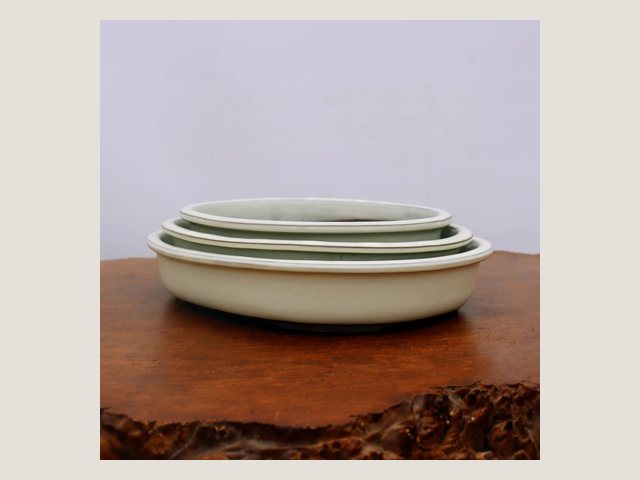
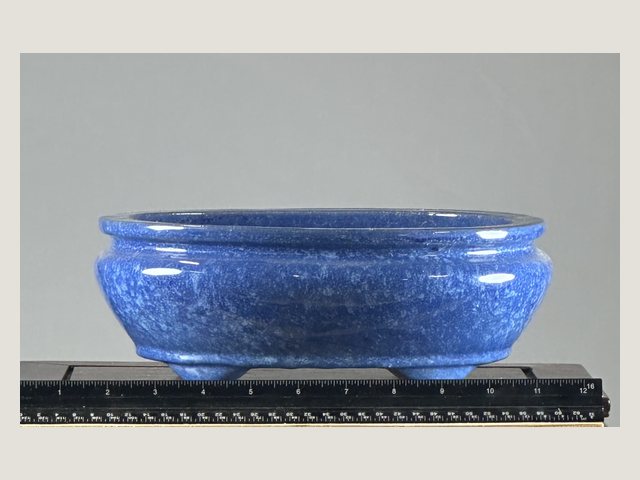
Glazed oval by Shuho (STJP1046) — Bonsai Learning Center
At 8.9 cm (3½ inches) tall outside, this oval is for a tree with a trunk around three and a half inches thick — a powerful ficus, an old broadleaf. Imported from Tokoname, in a mottled blue the photograph shows deep at the foot and paler at the rim. 25.4 cm long: a finished tree of about 38 cm, or 15 inches.
- Size
- 25.4 × 21.6 × 8.9 cm (10 × 8.5 × 3.5 in)
- Suits
- ~15" tree, ~3.5" trunk
- Origin
- "imported from the Tokoname region in Japan"
- Stock
- In stock — checked Nov 12, 2026
$200.00shipping included (seller)
Product page ↗II — Local Artisan Choice
An Ohio oval, for a slender trunk.
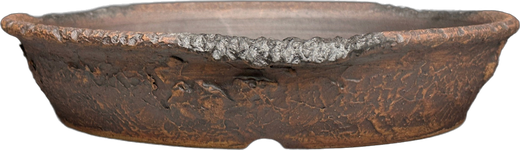
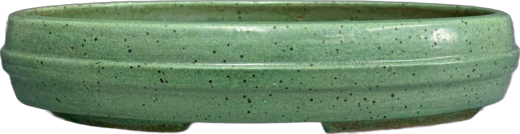
Chuck Iker oval, aged-copper patina green, 10" (26326) — Iker Bonsai Pots
The same 25.4 cm length, and a lesson in reading listings: 2 inches tall overall, but 1¼ inches deep inside — the potter states both. That inside depth suits a tree of the same height with a trunk around an inch and a quarter. Signed and one-off, from the potter's own shop in Batavia, Ohio, in a matte green with an aged-copper patina.
- Size
- 10 × 7¾ × 2" overall; 1¼" deep inside
- Suits
- ~15" tree, ~1.25" trunk
- Origin
- USA (Batavia, Ohio) — one-off, signed
- Stock
- In stock — checked Nov 12, 2026
$150shipping separate
Product page ↗III — First Practice
A Japanese production oval, for the middle trunk.
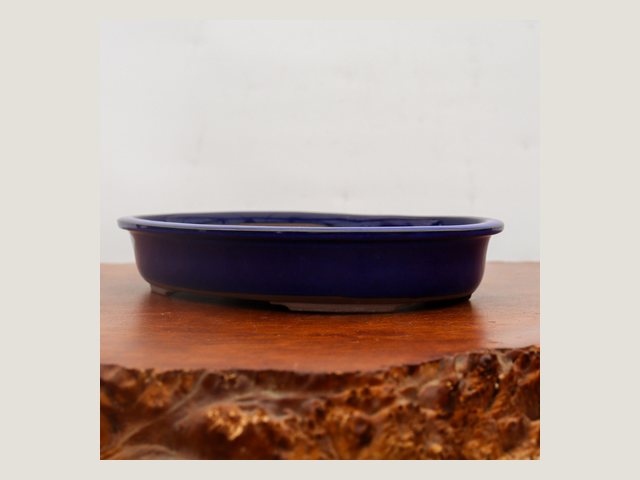
Dark blue glazed Japanese oval (No. 1552) — Bonsai Outlet
At 5.1 cm (2 inches) tall outside and 1½ inches deep inside, a pot for a trunk about 1½–2 inches thick; at 28.6 cm long, for a finished tree of about 17 inches. The same pot comes in 9 and 12 inches, so the calculator's length can be matched closely without leaving the price. Plain dark blue, "Origin: Japan" stated.
Shallower and handmade, for a slender trunk or a ficus growing aerial roots — John Fazzino's carved green oval, 24.8 cm, 1⅛" deep inside, $110.
- Size
- 11": 28.6 × 21.0 × 5.1 cm (also 9" and 12")
- Suits
- ~17" tree, ~1.5–2" trunk
- Origin
- "Origin: Japan"
- Stock
- In stock — checked Nov 12, 2026
$29.9511"; 9" $24.95, 12" $34.95
Product page ↗06 — THE ENSEMBLE
Proportion does not
stop at the pot.
The same arithmetic runs one step further: the stand or board under the pot. Japanese craft is beautiful — and because the beauty comes from the conventions, it can be built from what is near at hand.
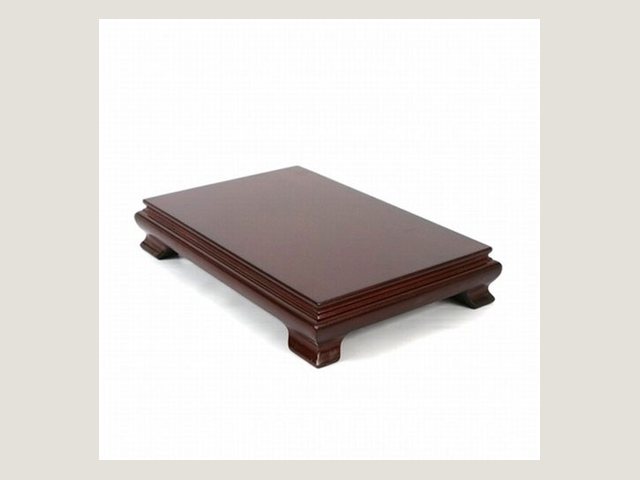
1 — THE STAND
Half a size
larger.
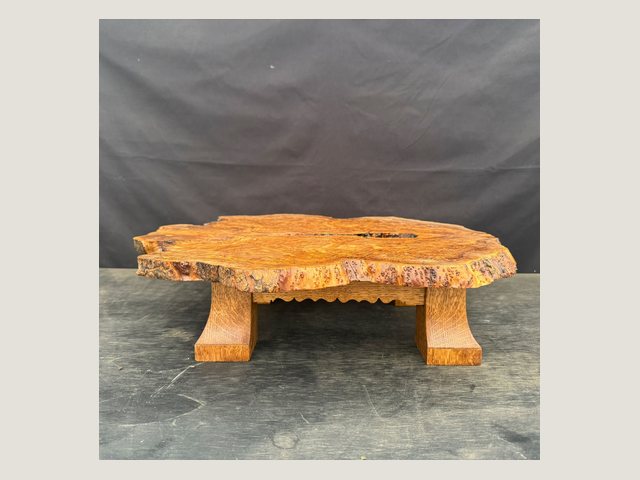
Bonsai Outlet's rule: a display stand about half a size larger than the pot — a 10-inch pot on a stand of about 15 inches.[3]
2 — THE BOARD
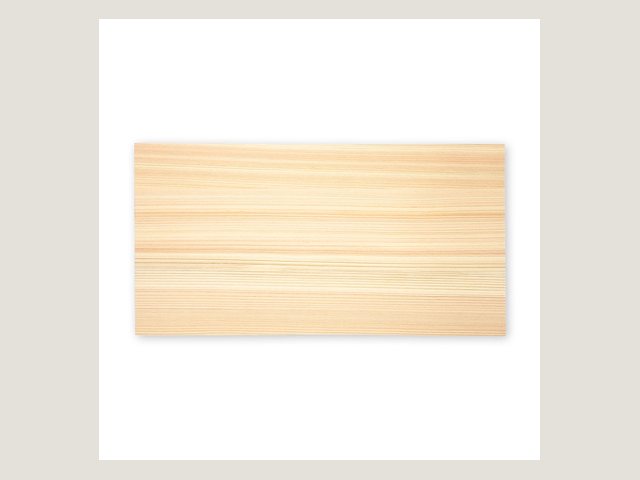
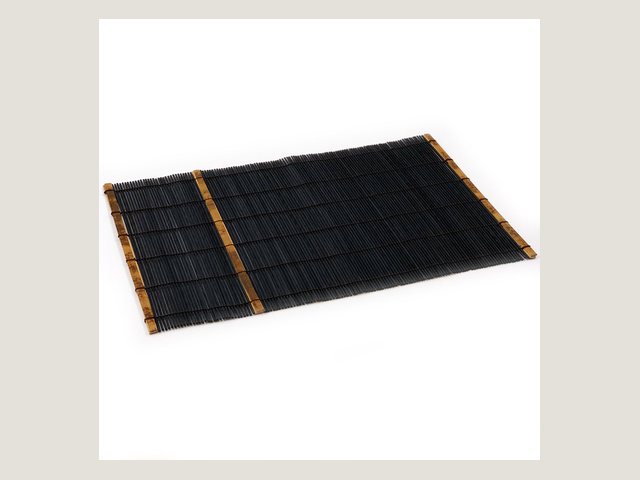
A flat ground
instead.
On a table or a sill, a board or mat does the stand's work: one size larger than the pot, quiet in colour.
3 — THE TRAY
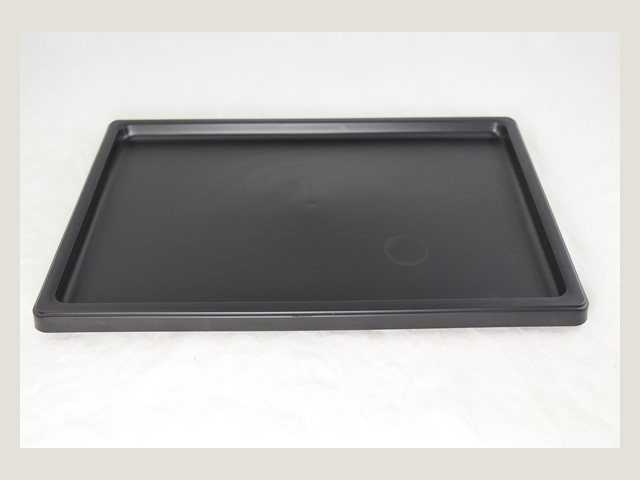
Indoors, a tray
one size up.
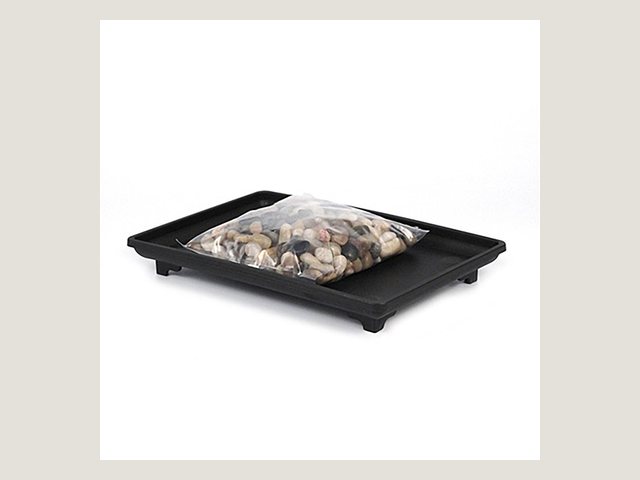
For an indoor tree the tray sits between pot and board, and takes the same arithmetic.
07 — BEFORE YOU HESITATE
The fears, answered
from the facts.
"My tree doesn't fit the rule."
Few do exactly. The rules are a starting band, and Bonsai Empire's own case study breaks the two-thirds rule for a tree whose crown is almost as wide as it is tall — because the large crown needs a large root system.[2] Health first, then proportion.
"A smaller pot will hurt the tree."
A finished bonsai reaches a small pot over years of repotting, its roots reduced a little each time.[2] Our practice: if yours came from a nursery pot, step down over two repottings rather than one, and choose the deeper of two sizes in between.
"I measured, but the listing is in the other unit."
The calculator switches between inches and centimetres. One inch is 2.54 cm; a 10-inch pot is 25.4 cm.
08 — BEFORE YOU PAY
The five-point
check.
- Height, spread and trunk caliper measured — on the tree, not from a photo
- Length within the calculator's band; depth near the caliper
- The listing's unit, and the order of its numbers
- Outside or inside depth — and the feet
- Drainage holes, and wire holes if the tree must be tied in
09 — QUESTIONS
Asked, answered.
What size pot does my bonsai need?
For an oval or rectangular pot, about two-thirds of the tree's height in length, and about the trunk's thickness in depth.[1] Use the canopy spread instead of the height if the tree is wider than tall.[3]
How deep should a bonsai pot be?
About as deep as the trunk is thick just above the surface roots.[2] Forests go shallower, cascades much deeper.[1]
How do you measure a bonsai pot?
Length and width across the outside at the widest points, height from the table to the rim. Where the seller gives an inside depth, use that for soil volume.
Sources
- Bonsai Empire — Bonsai pot (length ⅔ of height; depth and trunk base; forests, cascades).
- Bonsai Empire — Choosing a bonsai pot (depth at the trunk above the surface roots; round pots ⅓; wide crowns; trees in development; drainage).
- Bonsai Outlet — Bonsai pot sizing, shape, color and display guide (⅔ of spread for canopy styles; round pots ⅔; stand half a size larger).