
Direct answer
Give a ficus bonsai the brightest place you have — a south window, within about three feet of the glass, or a grow light 6–12 inches above it. Water thoroughly when the top of the soil turns slightly dry, never on a schedule. Keep it above 60°F, summer it outside if you can, and bring it in before nights fall to 55°F. Expect some leaf drop after any move; it usually recovers once light and water are steady.
Key takeaways
- Too little light is one of the most common causes of a weak, leaf-dropping ficus.
- Water on observation: thoroughly, when the surface is slightly dry; less in a cool winter room.
- In at 55°F nights, out when spring nights hold above it — and change places in stages.
- Prune back to two leaves after six to eight have grown; repot in warm weather, every two to three years.
- After a move indoors, wait about four weeks before pruning, repotting or feeding.
01 — LIGHT FIRST
The one fact that
decides the rest.
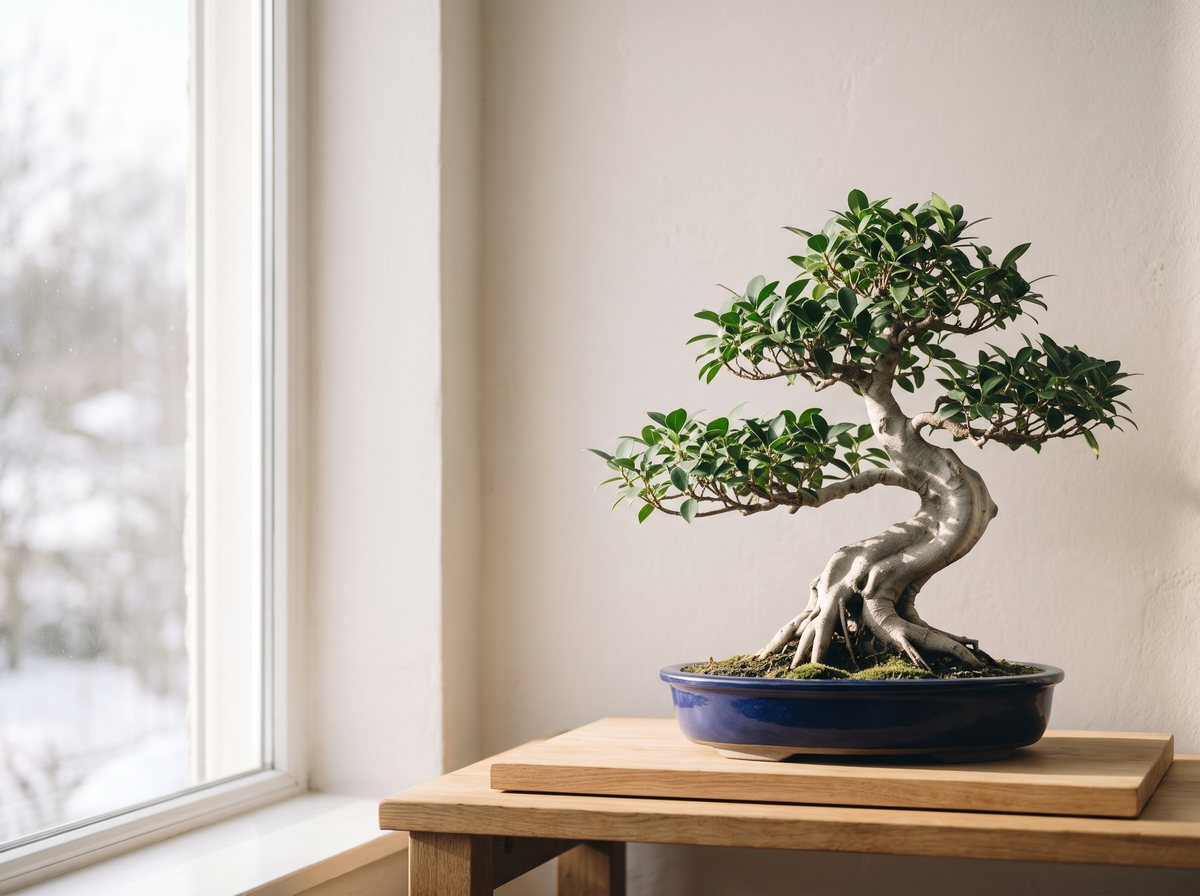
Most of the sources start in the same place. University of Missouri Extension puts it plainly: the first key to a healthy ficus is lots of light.[7] Bonsai Empire asks for several hours of direct sun a day — indoors, usually a south-facing window, with the tree within about 3 feet (1 m) of the glass because light falls off quickly with distance; too little light weakens the tree, enlarges its leaves and starts leaf drop.[2]
Ficus is still the forgiving one. Matthaei Botanical Gardens calls ficus one of the easiest bonsai to grow indoors, able to tolerate lower light and humidity than many tropicals — and adds that indoors, supplemental light is often necessary, with the grow light 6–12 inches above the tree.[5] Ficus microcarpa, the usual bonsai ficus, is hardy only in zones 9a–11b and is sold as a houseplant because it wants warmth all year.[1]
02 — THE CARE CALENDAR
One year, on
one table.
The temperatures in the sources differ by a few degrees. We use the conservative ones: inside before nights fall to 55°F, as Matthaei advises for tropical bonsai and Missouri Botanical Garden for the weeping fig,[4][5] and a room between about 60 and 85°F.[7] Bonsai Empire gives two figures — outside while temperatures stay above 60°F in its placement notes, and nights above 50°F in its FAQ — so 55°F sits between them.[2]
| Season | Where | Water and feed | Work |
|---|---|---|---|
| Spring | Out when nights hold above 55°F — in stages, a week or two in shade first | Water when the surface is slightly dry; feed every two weeks from late spring | Repot when nights stay above 60°F, every two to three years |
| Summer | Outside in sun, or the brightest window | Most water of the year; feed every two weeks | Prune back to two leaves after six to eight; wire, and check it often |
| Autumn | In before nights fall to 55°F; the brightest window | Water less as growth slows | Nothing for about four weeks after the move |
| Winter | Indoors, 60–85°F, away from drafts and heaters; grow light if the window is weak | Slightly moist in a cool room; feed every four weeks only if it keeps growing | Watch for scale and spider mites |
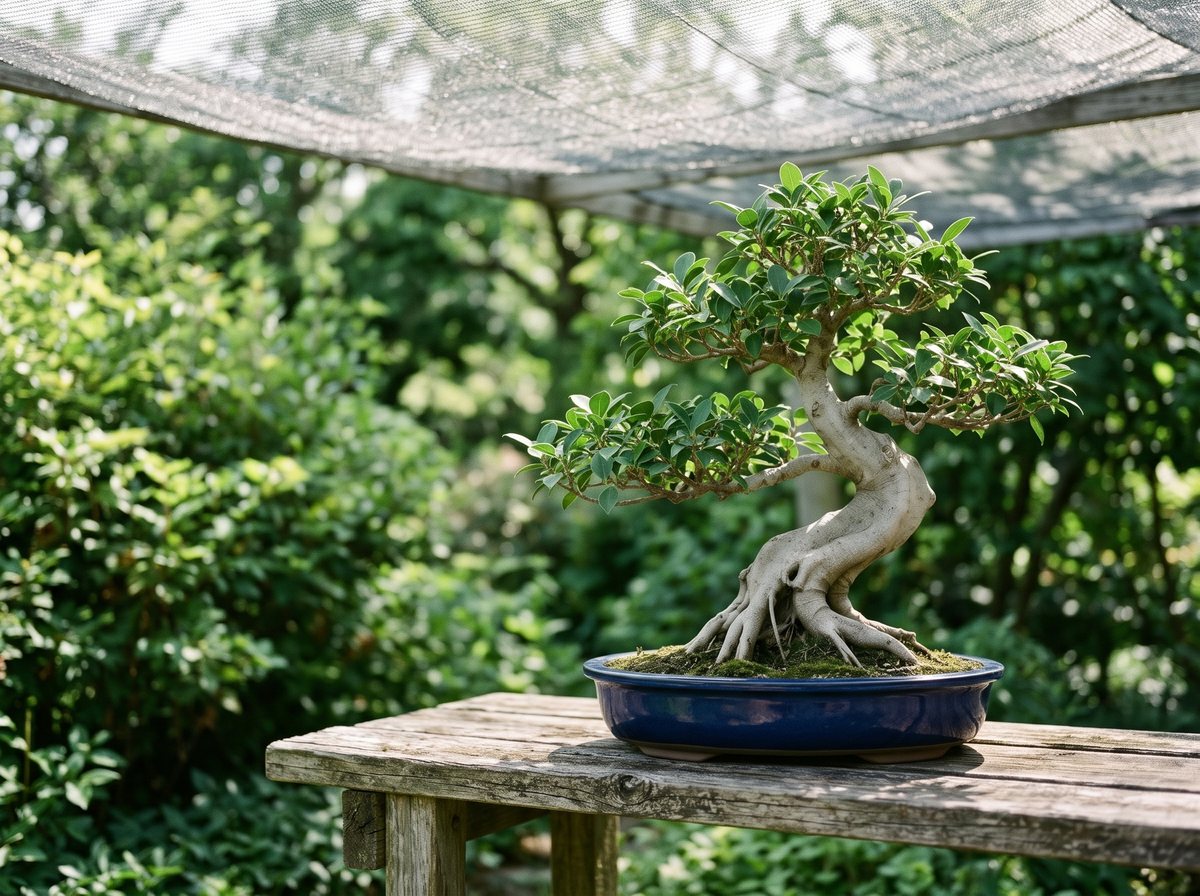
Feeding and pruning rhythm from Bonsai Empire;[2] repotting temperature from Bonsai Mirai;[3] the four-week pause from UF/IFAS.[6] In the warmest parts of zones 10–11 a ficus can stay outside most of the year; bring it in or protect it on any night forecast below 55°F — our reading.
03 — WATER AND AIR
The daily question,
answered by the soil.
Ignore labels that say "water every day." Bonsai Empire's rule is to water generously whenever the soil gets slightly dry; a ficus tolerates the occasional mistake either way, and a tree in a cool winter room needs only to stay slightly moist.[2] Missouri Extension's version: water as the top quarter to half of the mix dries, and do not overwater — too much water suffocates the roots.[7] Check daily; water only when needed. A tree that has dropped leaves takes up water more slowly, and wet soil then rots roots.[5]
Humidity is where the sources disagree. For growth, ordinary household humidity is fine.[7] For aerial roots, it is not: Bonsai Empire says they need humidity near 100%, created artificially under glass or clear sheeting.[2] Bonsai Empire also advises daily misting, warning that too much invites fungus; Iowa State finds misting raises humidity for only minutes and prefers a gravel tray, grouping or a humidifier.[9] Our reading: a tray under every indoor ficus, misting optional.
Do
- Water through until it runs from the holes
- Keep the pot above the water in its tray
- Turn the tree now and then for even growth
- Keep it off radiators and out of cold drafts
Don't
- Water by the calendar
- Leave the roots standing in water
- Move it from bright to dim in one step
- Repot, prune and feed in the month after a move
04 — PRUNING, WIRE, REPOTTING
A forgiving tree,
worked often.
Pruning. Let a shoot grow six to eight leaves, then cut back to two; that is how a ficus keeps its shape.[2] To thicken the trunk, let it grow freely for a year or two first — the hard cuts afterward do not harm it, and new shoots grow from old wood. Leaf pruning (defoliation) reduces leaf size. All figs bleed a milky latex sap from cuts; cover larger wounds with cut paste.[2]
Wiring. Thin and medium ficus branches bend easily, but wire bites into ficus bark quickly — check it regularly. Strong branches are better shaped with guy-wires, which can stay on much longer.[2]
Repotting. Ficus respond best to repotting in warm weather.[8] Bonsai Mirai's line is nights consistently above 60°F;[3] Bonsai Empire suggests every two to three years, in a basic bonsai soil, and notes that ficus tolerates root pruning very well.[2] The pot itself — glaze, form and depth — is in our ficus pots note.
05 — THREE PATHS, REAL TOOLS
The tools a ficus
actually asks for.
Shears for the constant pruning, and light for the winter. Not a ranking — three relationships with the same work. Each was live, priced and in stock on the day we checked.
Prices and stock checked November 12, 2026. As an Amazon Associate I earn from qualifying purchases. Links marked Amazon are affiliate links; other links are plain. Amazon prices are shown on Amazon.
I — Japanese Masterpiece
Handmade shears for the two-leaf cut.
Kaneshin bonsai shears No. 40E — Bonsai Outlet
A ficus is pruned all summer, shoot by shoot, back to two leaves. That work is done with shears, and these are made for it: a 55 mm blade on a 185 mm body, handmade by Kaneshin in Japan. Bonsai Outlet describes them as a basic tool for thinning and defoliating.
For the first year — all-purpose carbon-steel shears from Eastern Leaf, $17.95 (made in Taiwan).

- Size
- 185 mm, 55 mm blade
- Origin
- "Handmade Bonsai Scissors by Kaneshin in Japan."
- Use
- Summer pruning, twig work
- Stock
- In stock — checked Nov 12, 2026
$64.95shipping separate
Product page ↗ Stainless sibling (No. 827) on Amazon ↗II — The Well-Made Light
A grow light that looks like a lamp.
Soltech Aspect Gen 2 LED growlight — Soltech
For the ficus in a north room, or any winter short on sun. A 36-watt pendant in warm 3000 K white that reads as a room light rather than a grow tent, dimmable, with a timer in the box. Soltech hangs it 12–24 inches above full-sun plants. It is a pendant, so over a shelf it needs a ceiling hook or wall mount.

- Power
- 36 W, dimmable
- Hang
- 12–24" over full-sun plants (maker)
- Warranty
- 5 years (maker)
- Stock
- In stock — checked Nov 12, 2026
$200USD price on the maker's site
Product page ↗III — First Practice
A grow bulb for the lamp you already own.
SANSI PAR25 15 W LED grow light bulb — SANSI
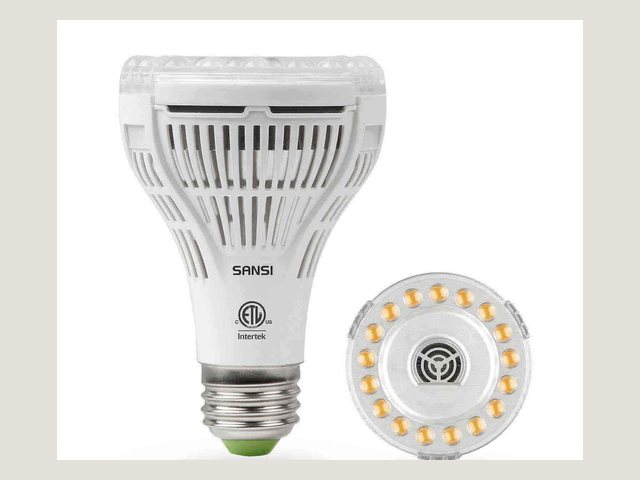
The cheapest real answer to a dark window: a full-spectrum bulb that screws into a clamp or desk lamp with a standard E26 socket (not a dimmable or fully enclosed fixture). SANSI says to keep it 30–50 cm from the leaves. Put it on a plug-in timer; under lights, extension guidance is no more than 16 hours a day.[10]
- Power
- 15 W, non-dimmable
- Distance
- 30–50 cm from the plant (maker)
- Socket
- E26; needs a lamp
- Stock
- In stock — checked Nov 12, 2026
$19.991-pack, US E26
Product page ↗06 — THE YEAR'S KIT
One kit,
four seasons.
A tray under the pot, a bag of soil for the repotting year, a roll of wire and one cutter for the hard cut. Japanese craft is beautiful — and because the beauty comes from the conventions, it can be built from what is near at hand.
1 — HUMIDITY
A tray of gravel
and water.
Gravel in the tray, water to just below the top, the pot sitting above it.[9] It also catches what runs from the holes.


2 — SOIL
A basic bonsai mix,
every few years.
Ficus asks for no special soil — a basic bonsai mixture at repotting.[2] Japanese akadama for the purist; a premix for everyone else.


Also on Amazon — hard Ibaraki akadama, small, 14 L ↗ · BonsaiJack #221, 2 qt ↗
3 — WIRE
Aluminum,
checked often.
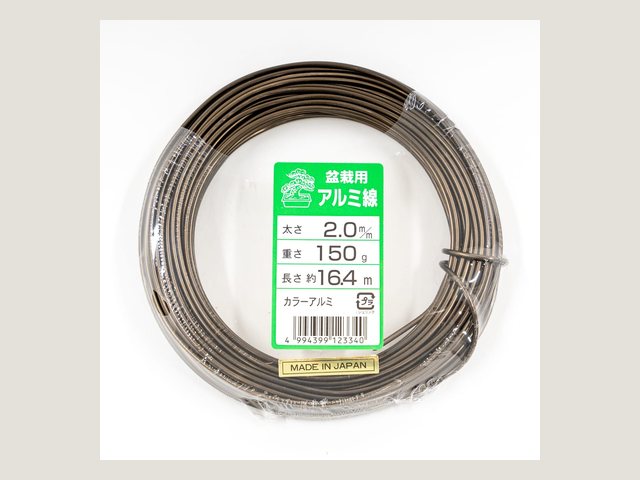
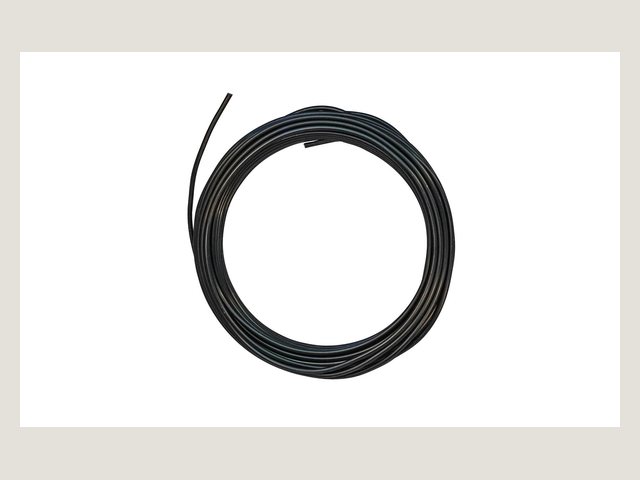
Ficus bark is soft and wire bites fast. Look every week in summer and unwind before it marks.
4 — THE HARD CUT
One cutter,
after a free year.
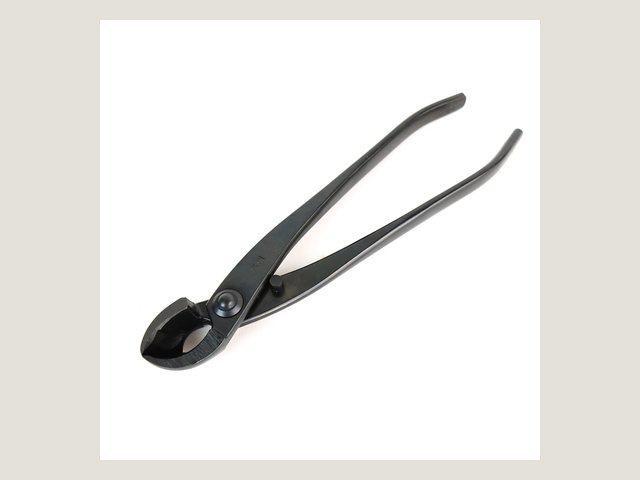
When a ficus has grown freely to thicken its trunk, the branches that come off afterward need a clean, hollow cut.
07 — WHEN IT LOOKS WRONG
Symptoms, read
calmly.
"It's dropping leaves."
Missouri Botanical Garden, writing about the weeping fig, lists the causes: sudden, significant changes in temperature or light, cold drafts, and under- or overwatering, and notes that a move from bright to dim often triggers heavy leaf drop; it suggests a week or two on a shaded porch before coming indoors.[4] Bonsai Empire ranks light and watering above a change of place.[2] Some leaf loss after moving indoors is normal,[5] and a sudden shed is not necessarily a sign of a problem unless the leaves keep falling over time.[7]
"The leaves are turning yellow."
Usually watering, low light or the stress of a move. Underwatering shows quickly, leaves yellowing and drying; overwatering and too little light show slowly. Water thoroughly if it has dried out, let the surface dry slightly between waterings if it has not, and give it more direct light. Older leaves yellowing now and then is normal.[2]
"There are specks on the leaves."
In winter, dry air and poor light weaken a ficus, and a weakened ficus can pick up scale or spider mites. Treat with an insecticide or miticide labelled for the pest — and fix the conditions, or they return. Bonsai Empire suggests plant lamps 12 to 14 hours a day during recovery.[2]
08 — THE WEEKLY CHECK
Five things,
once a week.
- The soil surface, before every watering — slightly dry, then water through
- Water in the tray, below the pot
- Wire on the branches, before it marks the bark
- The undersides of leaves, for scale and mites
- The night forecast in spring and autumn — 55°F is the line
09 — QUESTIONS
Asked, answered.
How often should I water a ficus bonsai?
When the top of the soil feels slightly dry, thoroughly, until water drains from the bottom — not on a fixed schedule. Usually more often in summer than in winter.[2]
Can a ficus bonsai live indoors all year?
Yes, with enough light and steady temperatures, away from drafts and heaters. Bonsai Empire notes it grows much better outdoors from spring to autumn if nights stay above 50°F.[2]
When should I repot a ficus bonsai?
Every two to three years (Bonsai Empire), when nights stay consistently above 60°F (Bonsai Mirai).[2][3] Not in the month after a move indoors.[6]
Should I mist my ficus?
It is optional. Bonsai Empire advises misting; Iowa State finds the effect lasts minutes. A gravel tray or a humidifier does more.[2][9]
Is a ficus bonsai safe around pets?
Bonsai Empire warns that ficus ginseng is poisonous to animals that eat the leaves; keep it out of a pet's reach.[2]
Sources
- NC State Extension Plant Toolbox — Ficus microcarpa.
- Bonsai Empire — Ficus bonsai care guide (placement, watering, fertilizing, pruning and wiring, repotting, pests, FAQ).
- Bonsai Mirai — Ficus bonsai (repotting temperature).
- Missouri Botanical Garden — Why is my weeping fig dropping leaves?
- Matthaei Botanical Gardens, University of Michigan — Horticulture at home: growing bonsai inside (2026).
- UF/IFAS EDIS — Cultural guidelines for commercial production of interiorscape Ficus (EP136).
- University of Missouri Extension, IPM — Ficus: 2026 houseplant of the year (D. Trinklein).
- Bonsai Tonight — Pruning and repotting an exposed root ficus (2020).
- Iowa State University Extension — How can I raise relative humidity indoors for my houseplants?
- University of Maryland Extension — Lighting for indoor plants.